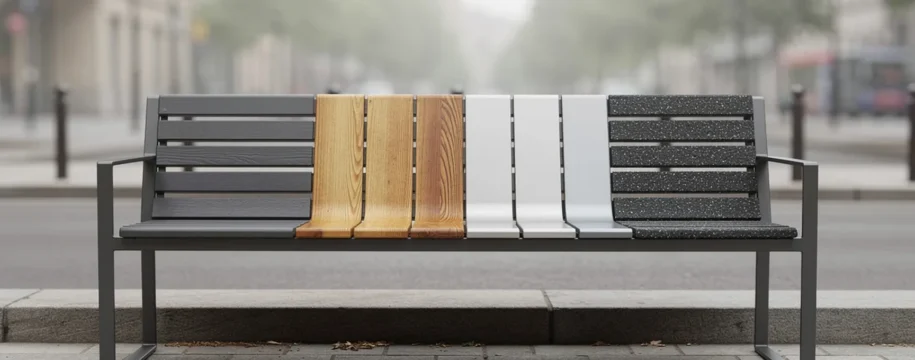
Choosing the right material for benches, bollards, planters and litter bins is one of the most consequential decisions a specifier will make on any public realm project. Steel, timber, aluminium and recycled plastic each bring a different balance of strength, appearance, maintenance burden and environmental impact, and the correct choice depends heavily on context: a coastal promenade, a school playground and a heritage town centre will each demand something different. This guide sets out how each material performs in practice, what upkeep it requires, and how the options compare on cost, durability and sustainability, so that landscape architects, local authorities and facilities managers can specify with confidence.
Steel street furniture: strength, durability and urban applications
Steel remains a mainstay of street furniture manufacturing because of its structural strength and versatility. It can be formed into frames, slats, bollards and litter bin housings, and it is frequently combined with other materials such as timber or recycled plastic to balance strength with a softer visual finish. The key consideration with steel is how it is finished and protected, since untreated steel is vulnerable to corrosion.
Galvanised steel vs Powder-Coated steel finishes
Galvanising involves coating steel in a layer of zinc, which forms a barrier against moisture and oxidation. It is a durable, cost-effective option for structural components that will be exposed to the elements over long periods. Powder coating, by contrast, applies a decorative and protective polymer finish, often over a galvanised base, allowing specifiers to select from a wide colour range while retaining corrosion resistance. Where appearance matters as much as protection, a galvanized-and-powder-coated combination is common, though both finishes rely on the coating remaining intact; any damage to the surface can expose bare steel to rust.
Corten steel and weathering properties for outdoor installations
Corten steel takes a different approach to corrosion resistance. Rather than relying on paints or coatings, it is designed to weather naturally, forming a stable oxidised layer, or patina, on its surface. This process typically takes one to three years to stabilise, after which the material reaches its characteristic warm red-brown colour and stops staining adjacent light-coloured surfaces. Because no chemical coatings are used in production, Corten avoids the waste and harmful substances associated with paint application, and its protective patina extends the product's working life without repainting. It has also proven useful in resisting stickers and graffiti, which tend to adhere poorly to its textured surface. These qualities have made it a popular choice for planters, litter bins and bollards in projects ranging from town centre rejuvenation schemes to school entrances, where its low-maintenance, long-lasting nature aligns well with circular economy principles.
Stainless steel grades for coastal and High-Corrosion environments
In environments where salt exposure is a persistent risk, such as coastal towns or heavily gritted urban roads, stainless steel is often specified for its superior resistance to rust and pitting corrosion compared with standard mild steel. Unlike galvanised or powder-coated finishes, stainless steel's corrosion resistance is inherent to the alloy itself, making it a durable option where surface damage could otherwise expose a weaker substrate to salt-laden air or de-icing chemicals.
Structural Load-Bearing capacity in steel benches and bollards
Steel's high strength-to-weight ratio makes it well suited to load-bearing components in benches, frames and bollards, particularly where impact resistance is a priority, such as in car parks and traffic management schemes. Steel bollards are commonly specified for vehicle restraint and pedestrian protection precisely because the material can absorb and withstand significant impact forces while maintaining structural integrity, provided the finish is properly maintained to prevent corrosion-related weakening over time.
Timber and wood species in street furniture manufacturing
Timber has been used in furniture making for centuries, valued for its natural aesthetic, workability and insulating properties. In street furniture, the choice of species and treatment method has a significant bearing on longevity and maintenance requirements.
Hardwoods: iroko, teak and european oak for Long-Term exposure
Hardwoods are generally favoured for street furniture intended for long-term outdoor exposure, owing to their density and natural resistance to decay. Many manufacturers deliberately avoid chemically treating hardwood elements, instead allowing the timber to weather naturally to a silvered or muted finish. This approach avoids the cost and environmental impact of repeated chemical treatment while still delivering durable, natural-looking furniture, as demonstrated in projects using responsibly sourced hardwood in parkland and public realm settings.
Softwoods: Pressure-Treated pine and redwood cost considerations
Softwoods such as pine and redwood offer a lower upfront cost than hardwood alternatives, but they are more susceptible to moisture absorption, swelling and rot if left untreated. Pressure treatment, which forces preservative chemicals into the wood under pressure, is typically required to extend the service life of softwood street furniture. This adds to the lifecycle cost and requires periodic reapplication or monitoring, which specifiers should weigh against the lower initial purchase price.
FSC certification and sustainable forestry standards
Forest Stewardship Council (FSC) certification confirms that timber has been sourced from responsibly managed forests, supporting steady forest regeneration, whether natural or through replanting, while preserving biodiversity and the balance of local ecosystems. Chain of Custody certification extends this assurance through the entire supply chain, meaning every company that fells, processes or uses the wood is independently certified, and working conditions for local populations involved in logging are also improved. PEFC certification operates on similar principles, providing an alternative but equally recognised sustainable forestry standard. For publicly funded projects in particular, specifying FSC or PEFC-certified timber provides a documented, auditable basis for sustainability claims.
Timber preservation techniques: tanalising and UV-Resistant coatings
Tanalising is a pressure treatment process commonly applied to softwoods to improve resistance to rot, fungal decay and insect attack. UV-resistant coatings and stains can further protect timber surfaces from sun damage, which otherwise causes fading, greying and surface checking. However, both approaches require ongoing maintenance: coatings need reapplication as they wear, and treated timber should be inspected periodically to ensure the preservative barrier remains effective. This ongoing upkeep is a key point of difference when comparing timber's lifecycle cost against corrosion-resistant metals or recycled plastics.
Aluminium street furniture: lightweight design and corrosion resistance
Aluminium offers a distinctive combination of light weight and natural corrosion resistance, making it a practical choice for street furniture components where ease of handling and installation matters, such as signage frames and litter bins.
Anodised aluminium finishes for enhanced weather protection
Anodising is an electrochemical process that thickens the natural oxide layer on aluminium's surface, improving its resistance to corrosion and wear while also allowing for a range of decorative finishes. This makes anodised aluminium particularly suitable for street furniture exposed to variable weather conditions, since the treated surface resists the pitting and discolouration that can affect untreated metal over time.
Extruded vs cast aluminium manufacturing processes
Extrusion forces heated aluminium through a shaped die to create long profiles with a consistent cross-section, a process well suited to producing structural frames, slats and linear components efficiently. Casting, by contrast, involves pouring molten aluminium into a mould, making it better suited to more complex or decorative shapes such as bollard heads or ornamental brackets. The choice between the two processes typically comes down to the complexity of the component required and the production volumes involved.
Aluminium alloy grades used in litter bins and signage frames
Different aluminium alloys offer varying balances of strength, corrosion resistance and workability, and the appropriate grade depends on the structural demands of the component. Litter bins and signage frames generally prioritise corrosion resistance and light weight over maximum structural strength, since these items are not typically subject to the same impact loads as bollards or barriers. Aluminium's recyclability is a further advantage: recycling aluminium delivers energy savings of around 95% compared with producing virgin metal, and roughly half of all aluminium currently in use in Europe is estimated to have been recycled at least once.
Recycled plastic and composite materials in sustainable urban design
Recycled plastic has moved from a niche alternative to a mainstream specification choice across public realm design, education estates and transport infrastructure, driven by its combination of durability, low maintenance and reduced environmental impact.
HDPE recycled plastic lumber for benches and planters
High-density polyethylene (HDPE) is the most common base material for recycled plastic street furniture, chosen for its strength, stability and resistance to environmental degradation. It is processed into structural planks, profiles or moulded components before fabrication into benches, planters and bollards. Unlike timber, which relies on surface treatment for protection, or steel, which depends on coatings, recycled HDPE is inherently resistant to the elements throughout its entire structure. It does not absorb water, so it will not swell, crack or rot in wet conditions, and it performs well in freezing temperatures, avoiding the freeze–thaw damage that affects porous materials. Some recycled plastic products also use mixed polyolefin blends recovered from household and industrial plastic packaging waste.
Post-consumer vs Post-Industrial plastic waste streams
Recycled plastic street furniture is typically manufactured from a combination of post-consumer and post-industrial waste. Post-consumer plastic comes from household packaging and other discarded items collected for recycling, while post-industrial plastic originates from manufacturing offcuts and industrial processes. Some manufacturers have gone further, developing seating and litter bins from thermoplastic polymer produced using recovered marine plastic waste, including discarded fishing nets, or ocean plastics. This approach helps address marine pollution directly while producing a durable, fully recyclable end product.
Carbon footprint reduction through recycled composite materials
Using recovered plastic waste as a raw material helps divert material from landfill and reduces reliance on virgin plastics, which are typically derived from oil and carry a high initial carbon cost. Beyond the material sourcing itself, recycled plastic furniture's extended lifespan and minimal maintenance requirements reduce the need for frequent replacement, lowering resource consumption, transport requirements and manufacturing demand across a project's lifecycle. Some ranges are further supported by independent certification, such as the Nordic Swan Ecolabel, which assesses the production and lifecycle impact of products intended for public and community spaces. Bio-based composites, incorporating materials such as hemp fibre, dried grass or residual wood content, represent a further development in this space, offering an additional route to reducing dependence on fossil-derived raw materials.
Colour retention and UV stabilisation in recycled plastic products
UV-stabilised recycled plastic products are formulated to retain their structural integrity and appearance over time, even in warmer climates or under sustained sun exposure. This is an important consideration, since colour fading and surface degradation are common concerns with plastic products generally. Modern manufacturing techniques have also improved the aesthetic range available, with wood-effect finishes and a wider palette of colours now allowing recycled plastic furniture to integrate naturally into landscaped, historic or contemporary settings, addressing a limitation that affected earlier generations of recycled plastic products.
Comparative analysis: material selection criteria for urban environments
No single material is universally superior; the right choice depends on the specific demands of the installation site, budget constraints and design priorities.
Maintenance requirements across steel, wood, aluminium and recycled plastic
| Material | Typical Maintenance Needs |
|---|---|
| Untreated/coated steel | Periodic repainting or recoating to prevent corrosion; inspection of coating integrity |
| Corten steel | Minimal; no coating required once patina has stabilised |
| Stainless steel | Occasional cleaning; inherently corrosion-resistant |
| Softwood timber | Regular treatment reapplication; monitoring for rot and insect damage |
| Hardwood timber (untreated/weathered) | Minimal; natural weathering accepted as part of the finish |
| Aluminium | Low; anodised finishes resist corrosion with little upkeep |
| Recycled plastic | Very low; occasional washing only, no painting, staining or sealing |
Life cycle costing and total cost of ownership calculations
While initial purchase price is an important factor, total cost of ownership should account for maintenance frequency, expected service life and eventual replacement or disposal costs. Materials that avoid the need for repainting, staining or chemical treatment, such as Corten steel, anodised aluminium and recycled plastic, tend to deliver lower costs over the full lifespan of an installation, even where the upfront cost is higher than a treated softwood or untreated mild steel equivalent. Recycled plastic and durable metals also reduce disruption in public spaces, since replacement and refurbishment work in busy urban locations can itself be costly and disruptive to plan around.
Vandal resistance and Anti-Graffiti treatments by material type
Vandal resistance varies significantly by material and finish. Recycled plastic and dense hardwoods generally resist scratching and impact well and do not splinter, which is a particular safety advantage in schools and playgrounds. Corten steel's textured, oxidised surface resists stickers and graffiti adhesion. Powder-coated steel and anodised aluminium can be more vulnerable to surface damage from vandalism, since scratches or chips may expose the underlying metal to corrosion, though specialist anti-graffiti coatings can be applied to mitigate this risk where high-traffic or high-vandalism locations are a known concern.
Regulatory standards and specifications for street furniture materials
BS EN standards governing public realm furniture in the UK
Street furniture specified for UK public realm projects is generally expected to meet relevant British and European standards covering structural performance, safety and material durability. These standards provide a consistent basis for comparing products from different manufacturers and materials, and compliance is often a prerequisite for public sector procurement, particularly for items such as bollards used in traffic management or barriers used for pedestrian safety.
Accessibility compliance under the equality act 2010
Inclusive design is a legal as well as practical consideration in street furniture specification. Under the Equality Act 2010, public spaces and the furniture within them must be accessible to all users, which means seating height, spacing and circulation routes need careful thought at the design stage. This is particularly relevant for publicly funded projects, where compliance with accessibility standards is a mandatory part of the specification process rather than an optional design enhancement.